A lot of people want to know what is going on inside the Department of Homeland Security. Since its inception, the DHS has attracted an unusually high number of Freedom of Information requests compared with other departments, according to a News 21 review.
In Fiscal 2005, the department received 163,016 new requests for undisclosed information.
That compares with 81,304 at the Department of Defense, 51,516 at the department of Agriculture, and 4,602 at the Department of State. The pattern is the same for requests that were still pending at the end of fiscal year 2004. Homeland Security still had 45,701 requests pending compared with 12,424 at the Department of Defense, 2,371 at the Department of Agriculture, and 1,996 at the Department of State.
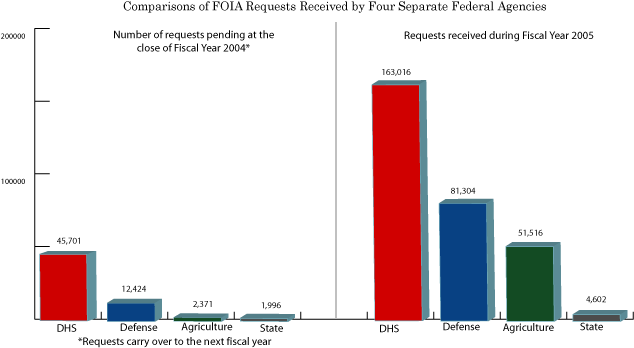
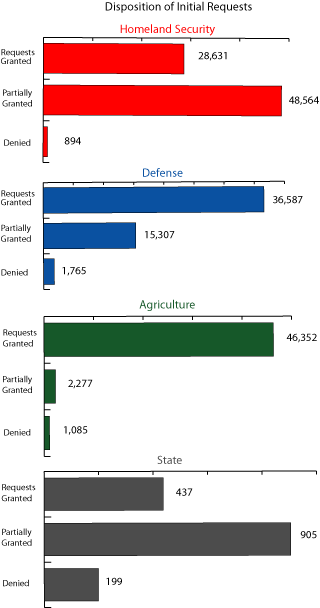
The percentage of requests partially or totally denied by DHS is also high. For Fiscal 2005, for instance, out of 78,089 initial requests that were settled without appeal, DHS partially denied 62% and totally denied 1%, for a total of 63%.
By comparison, the Defense Department partially or totally denied only 31% of information requests and the Department of Agriculture denied only 6% of requests received. The percentage of denials at the State Department was also high, however, at 70% of total requests (initial requests don’t include those that were subsequently appealed or which are undergoing other processing).
The Freedom of Information Act, which mandates that federal agencies comply with citizen requests for government records, was first passed by Congress in 1966. But not all government information is available to the public. To protect the interests of national defense, foreign policy and personal privacy, the Freedom of Information Act established nine exemptions.
Each department or agency keeps a record of the number of requests that were fully or partially denied and by which exemption. The exemptions most used by the Department of Homeland Security in fiscal year 2005 involve an agency’s personnel rules, internal governments and personal privacy.
The exemption used most often by DHS – 33,700 times – denies access to documents related only to internal personnel rules. The department used another 32,981 exemptions to deny requests for documents that are inter- or intra-agency memoranda, or letters that would be protected under court of law. And it used another 24,781 times the exemption that forbids permission to view personal, medical or other similar information whose disclosure would constitute an unwarranted invasion of privacy.
 Print
Print Bookmark