Over the past decade, annual spending by all federal government entities in the homeland security market has grown from just under $17 billion in 2001 to about $50 billion today - a 195 percent increase. While that amount is a tiny slice of the total U.S. economy (less than half percent), and a small share of total federal spending (about three percent), it's still a pretty big business - bigger, for example, than either the music or biotechnology industries.
And, the homeland security business stretches way beyond serving the government – to trade magazines and conferences by the dozens and, more important, to private companies that now monitor everyone who goes in and out of their offices and pay for back-up office space in case of a terrorist attack.
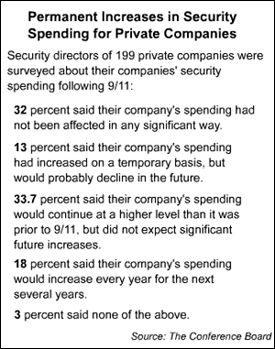
A February 2003 survey of 321 security officials at large companies by the Conference Board, a non-profit economic research firm in New York, found that just over half of their companies had permanently increased their security spending. Most of the money, the survey says, went to upgrading the cameras, guards and entryways at corporate facilities. Companies in critical industries - which include transportation, energy, financial, telecommunications and healthcare companies - were more intent on protection. Just over 56 percent of them said their spending on homeland security products would be indefinitely higher.
No one seems to have calculated exactly how big the entire homeland security market is, largely because it encompasses segments of so many other industries. But many of the same companies that sell anti-terror goods to the federal government also market their technologies to the private sector. And companies, particularly those like financial institutions that are the likeliest terrorist targets, are spending much more on products that are also high on the Department of Homeland Security’s procurement list.
Within government spending, the Department of Homeland Security accounts for the largest share of anti-terror spending – $27 billion in fiscal 2006 (the rest of DHS's $ 54.8 billion budget goes toward other activities such as the Coast Guard's search and rescue mission and fisheries enforcement), according to an analysis by the American Enterprise Institute. Other governmental entities account for the remaining $23 billion in homeland security spending, including the departments of Defense, Justice and Energy.
DHS divided the homeland security sector into six missions that help to define what products and services belong to the market:
1. Intelligence and Warning
2. Border and Transportation Security
3. Domestic Counterterrorism
4. Protection of Critical Infrastructure
5. Defense Against Catastrophic Threats
6. Emergency Preparedness and Response
Big defense contractors are the main suppliers within the homeland security market. Lockheed Martin, Boeing and General Dynamics established homeland security divisions after the September 11 attacks and the creation of DHS. According to Michael Soni, president and CEO of Cronus Capital Markets, a sector-research firm, the longstanding relationships between these large firms and the federal government gives them an advantage over smaller firms. Nevertheless, an analysis of federal contract data found that 34 percent of the money spent by DHS and its agencies since October 2001 has been awarded to small companies.
Edward Tyler, who in fall 2001 founded Government Security News, a trade publication, said the demand for information on homeland products has been increasing gradually. “We’ve gone from a quarterly publication, to a monthly publication, to a biweekly publication,” Tyler said.
Growth in conferences has kept pace as well. Where there were none just a few years ago, there are many now. And conference organizers said that they’ve had no trouble filling their exhibition halls and attracting participants. The National Homeland Defense Foundation, for example, will hold its fourth annual conference on the industry in October, and around 1,000 people are already expected to attend – up from 600 in 2003. Attendees pay $785 or $885 to come, depending on when they register. The foundation has already had to double the amount of space available for vendors this year because of the huge growth in businesses that have signed up, said Laurie Hann, the foundation’s conference organizer.
HomelandDefenseStocks.com, a website that gathers and publishes information about the homeland security and defense industries, has been inundated with requests from conference organizers who want their homeland conference listed on the site, said Dawn Van Zant, the Web site’s president. There are so many conferences now, Van Zant said, that conference planners are beginning to specialize in areas within homeland security. To differentiate their shows, they are focusing on topics like biometrics, maritime security and border protection.
Lynn Perciasepe, the trade show manager at HS Today, an industry publication, said the space devoted to homeland conferences has grown. Last year, the magazine had listed 22 conferences on homeland security by the end of the year. So far this year, they’ve registered 30. “I get inundated with emails everyday about homeland security events,” Ms. Perciasepe said, “and there are tons of them out there that we can’t even track down.”
To track the dynamics of the homeland security market, in June 2004 Soni created the Homeland Security Index (HSX) - composed of 30 large, medium and small companies that focus their activity exclusively on homeland security products and services. Some of the stocks include L-3 Communications, McAfee and Unisys. Larger defense contractors are not included, since it's not possible to separate their homeland security activities from their overall operations. Soni's index shows that the homeland security market is booming: over the past five years, the HSX companies have returned 25 percent to investors, compared with 10 percent for the Standard and Poor's 500.
How fast homeland security spending will increase is hard to predict - partly because it will depend on the incidence of future terrorist activity. The HSX index, for example, rose sharply after the London subway attacks in July 2005. In this case, in other words, what's good for homeland security companies may not be good for the United States - or anyone else.
 Print
Print Bookmark