On a recent day in June, Gregory D. Rothwell recalled his grim first day at work as the Department of Homeland Security’s first chief procurement officer. It was a big job: he was charged with overseeing the acquisition of $14 billion worth of goods and services per year, ranging from pistols for the Coast Guard to the baggage-screening system for the nation’s airports. “They didn't even have a zip code,” he said with a laugh, remembering his office at 7th and D Streets in northwest Washington, DC. “There were no systems, no processes in place, and a lot of expectations. And it was the worst office space I’ve worked in 34 years.” In December, 2005, after just two years on the job, Rothwell left DHS, taking early retirement at age 55, and headed for the private sector.
The deck at DHS was stacked against Rothwell from the start. Like the entire department the procurement effort was understaffed, underfunded, and hampered by a flawed integration plan for the 22 federal entities that were mashed together to create the new department. Serious procurement problems abounded, many leading to poor oversight of contracts worth billions of dollars each and significant waste of taxpayers’ money. DHS’s reputation for procurement incompetence became so established that even contracts that were handled effectively were routinely cited as examples of mismanagement. Hordes of critics, including former DHS executives, watchdog groups, the Government Accountability Office (Congress’s investigative arm) and Congressmen by the dozens have excoriated the department’s procurement record. Only now are some of the basic problems being addressed, and it remains unclear whether Rothwell’s efforts to bring order to DHS procurement and further steps being taken by his successor, Elaine Duke, will fix them.
Herding Cats
Even before the Homeland Security Act was signed on November 25, 2002, the federal government had embarked on a homeland security spending binge that saddled the new department with problems. One mismanaged contract awarded to NCS Pearson, a technology company, to federalize airport screening personnel ballooned from $104 million to $741 million. A luggage-screener contract had been awarded to Boeing for $1.2 billion, despite the fact that Boeing was the highest bidder, according to Clark Kent Ervin, the Inspector General at the time, who has written a book about his experiences. He found that the government overpaid Boeing by $49 million. More recently, the widely publicized cases of procurement abuse and mismanagement at DHS’s Federal Emergency Management Agency (FEMA) in the wake of hurricane Katrina have shown how badly the department handled its purchases.
Rothwell, now working as a consultant for Booz Allen Hamilton, had the perfect resume for the CPO job, having spent 34 years in government service, including more than a decade as a top manager at the IRS, overseeing some 5,000 employees whose duties ranged from procurement to customer service. He also had a stellar reputation for managerial competence and innovation in procurement. He has won many awards, including three “Presidential Rank Awards” (the highest honor given to civil servants) – one from President Clinton, two from President Bush. “I think Greg inherited a mammoth task and he did a terrific job, given the circumstances,” said Stan Z. Soloway, president of the Professional Services Council, a national association of companies that provide services to the government.
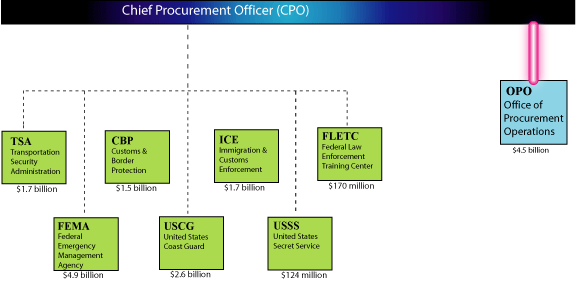
But when Rothwell took over as DHS’s first chief procurement officer, the fundamental problem he faced (and the root of many of the department’s continuing problems) was organizational: Seven of the 23 agencies and departments brought together to form DHS arrived with complete procurement shops of their own, including the Coast Guard, FEMA and the Transportation Security Administration. The others brought fragments from the agencies from which they had been torn.
Worse, DHS was organized so that the departments with their own procurement shops maintained authority over their acquisitions “buys,” leaving the CPO with only “dotted-line authority” over them; he could exert influence – perform audits, provide oversight, make policy suggestions – but could not enforce anything. “It’s not ideal, from my perspective,” said Rothwell. “Rather than working with them to create a world-class acquisition environment, you have to work on an exception basis. You don’t really find out about things until they go wrong.“
Trying to solve his organizational problem, Rothwell created the Office of Procurement Operations (OPO), which served the 16 agencies that came to DHS without their own procurement shops, plus the 34 offices that were newly created, like Science and Technology and the Information Analysis and Infrastructure Protection (IAIP). Those two offices alone counted for $2 billion in procurement spending in 2003. By 2005 OPO purchased just $3 billion worth of goods and services, while the seven independent procurement shops acquired $11 billion. So, to create some semblance of a unified whole, Rothwell established a council with the heads of all the DHS procurement shops that met regularly to discuss their operations. Still, communication and coordination problems persisted.
“If you know that these eight procurement offices are spending $6 billion a year on information technology, and if you know they’re sitting in eight different offices a ten minute drive from each other, why not consolidate them and have all of your IT bought by one centralized buying office?” Rothwell said. “I would have been able to do that with direct line authority. Without it, you can’t do it. You can’t even begin to touch it.”
Ervin agrees. “One of the key reasons the department is as dysfunctional as it is is that three key management officials at the department – the chief financial officer, the chief information officer and the chief procurement officer – do not control their nominal subordinates at the component level,” he said. “If you had one CPO who was making purchasing decisions for the department as a whole, at a minimum, he or she would know what was going on.”
Understaffing
The second major problem with DHS’s procurement process was a lack of personnel. "There were just too few procurement officials,” says Ervin. “They were overwhelmed in the contracting process given billions that had to be let." According to a GAO report, Rothwell’s OPO had merely 19 staffers supporting about $2 billion in contracts, or 21 percent of DHS’s 2004 obligations. “That year,” the report said, “Procurement Operations contracting staff on the average handled $101 million per employee, whereas the contracting staff for the Federal Law Enforcement Training Center on the average handled close to $2.7 million per employee.” (The Federal Law Enforcement Training Center is one of DHS’s seven independent procurement offices.)
One reason for this wild imbalance – and a general reason for the understaffing at the department – is rooted in administrative changes made a decade earlier. During the “good governance” era of the Clinton administration, the entire federal procurement system was revamped, making it easier to choose a contractor and less complex to manage a contract once it was issued, said Steve Kelman, a professor at Harvard University’s John F. Kennedy School of Government. At the same time, the overall federal workforce was cut back. Kelman served as administrator of the Office of Federal Procurement Policy at the U.S. Office of Management and Budget from 1993 to 1997, and is considered a leading expert on federal procurement practices.
The Procurement Boom
Contracting problems arose, however, as the Bush administration increasingly turned to outsourcing federal jobs – in everything from the Iraq War and its aftermath to homeland security – and overall procurement spending at DHS rose from $6.74 billion in 2003 to $17.5 billion in 2005. It’s not an inherently bad thing that the government contracts out work it believes can be done more efficiently by the private sector. But, said Kelman, “the consensus is that even those who believe the system was lean and mean in the ‘90s would say that during these last five or six years, when the dollars going to contracting have gone up without the contracting workforce going up at all – well, they’re understaffed.”
Rothwell was even more direct. “Money and people,” he said. “They need money and people.”
Compounding DHS’s procurement problems, the audit function – the internal watchdog that’s supposed to ensure money is spent effectively and efficiently – was also understaffed. Former Inspector General Ervin said his attempts to beef up the audit staff for procurement were stymied by DHS Under Secretary for Management Janet Hale. “They needed more people with the requisite expertise in accounting for extremely complicated financial transactions, and the lack of that kind of expertise,” Ervin said, led to “the financial dysfunction and the operational dysfunction that we have seen, really, since day one of the department.” Hale resigned from the department in April and was unavailable for comment.
Waste, Fraud and Abuse
Criticism of DHS contracting has been widespread, bipartisan, and is supported by numerous, detailed reports by the Office of the Inspector General and the GAO, and much of the criticism is well-founded. The department, for example, failed to adequately supervise a $1 billion contract the Transportation Security Administration signed with Unisys Corp. in Aug., 2002 to upgrade computer networks at airports. The DHS’s inspector general later found gross overcharges. Another example is ISIS, a failed $239 million system for installing cameras along the border that the Inspector General cited for substantial cost overruns and months-long delays. “In my view, the ISIS program is nothing less than the poster child for government waste and mismanagement,” said Mike Rogers (R-Ala.), the chairman of the Homeland Security Committee’s Subcommittee on Management, Integration and Oversight, at a committee hearing.
Most recently, a scathing report by Rep. Henry Waxman’s (D-Calif.) office that cited contract problems government wide called special attention to several major homeland security projects, and included an entire section on Katrina contracts. Waxman is the ranking minority member on the Committee on Government Reform, the main investigative committee in the House of Representatives and has been a vocal critic of DHS’s contracting.
Acknowledging the pressure Congress put on Homeland Security to be up and running very quickly, Waxman said, “There is obviously a tension between the rush to address the threat and establishing competent, well-managed contracts.” But the congressman has charged that poor planning, noncompetitive awards, abuse of contract flexibilities, inadequate oversight and corruption have undermined homeland security initiatives. “My biggest concern,” he added, “is that the Bush administration refuses to learn from its mistakes.”
Other DHS contracts that Congress has criticized, however, seem more like examples of the general perils of the federal procurement practices than of particular of problems at DHS. The department, for example, was criticized for awarding a $229 million contract to Bearing Point, a management and technology company, for an IT project called eMerge2 in Sept., 2004. A month later, the CEO and CFO resigned, and the company had to restate its earnings statements. Even more problematic, at the time DHS awarded the contract, BearingPoint had a $472 million contract with the Veteran’s Affairs in Florida terminated. “In the real world for real people, if a contractor utterly fails in his end of a contract, they don’t get another one,” said Charles Tiefer, a law professor at the University of Baltimore School of Law and former solicitor and deputy general counsel of the U.S. House of Representatives.
Rothwell, however, maintained DHS had done due diligence and was convinced the company could do the job. When the problems emerged, so to speak, DHS stopped work on eMerge2, a noncommittal way of canceling the contract, after spending only $9 million – four percent of the total, according to Steve Lunceford, a spokesman for BearingPoint. Although it appears to have been a bad decision to grant the contract in the first place, the Kennedy School’s Kelman said eMerge2 can actually be viewed as an example where the department was agile, and able to correct itself quickly. “There are a number of failed IT systems that are not cut off nearly as fast as DHS did with eMerge2,” Kelman said.
Ironically, the continual cries of “waste, fraud and abuse” – especially following the department’s response to Hurricane Katrina – may be exacerbating the very problems that they’re criticizing. “The environment on the Hill is so partisan,” said the Professional Services Council’s Soloway, “that it’s really affecting the acquisition community. We just finished a survey we do every two years of senior procurement officers, and one of the themes, loud and clear, is that this kind of ‘Gotcha!’ world that Congress seems to be in right now is really beating them down. No one is denying that there are problems, but with the degree of vitriol surrounding procurement, they’re scared. People are not only scared of making a mistake; they’re scared of making a decision.”
Fixing the Problems
There are reasons to hope DHS may get its procurement act together, both in terms of organization and staffing. “They’re getting there,” said the Kennedy School’s Kelman, citing the efforts of current Chief Procurement Officer Elaine Duke. “In the last several months, you’ve seen her bring in some very significant people to fill out the management.” Duke also is a member of the “Breakfast Club,” a small group that meets regularly to strategize about ways to improve government, whose members include Rothwell, Soloway, a member of the Council for Excellence in Government and former federal executives now in the private sector. (Duke declined numerous requests for an interview with News21.)
And – after years of complaining about the effects on contract outcomes from chronic understaffing – Congress recently approved funding for additional DHS procurement personnel. According to DHS spokesman Larry Orluskie, there will be an increase in the acquisition workforce beginning in October, 2006.
What hasn’t changed, unfortunately, is the jury-rigged organizational scheme of the DHS procurement process. Duke and her successors still have to work around that, as well as the rancorous mood on Capitol Hill, which shows no signs of mellowing in the foreseeable future.
 Print
Print Bookmark