A shorter version of this article was published on August 2, 2006 in the Pasadena Star-News.
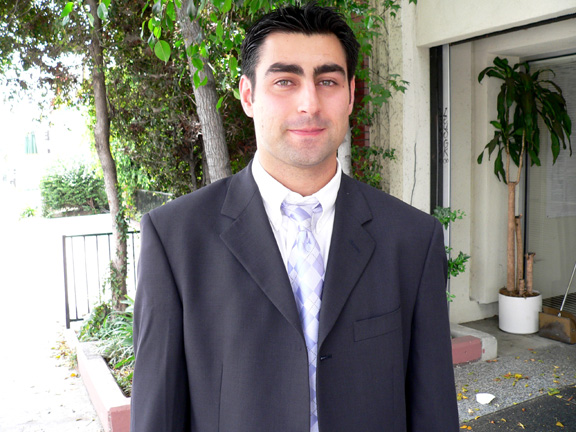
LOS ANGELES -- Two local civil rights and community groups turned in frustration to the courts Tuesday on behalf of 10 area residents, all Muslims, whose citizenship applications have been delayed years beyond the legal limit.
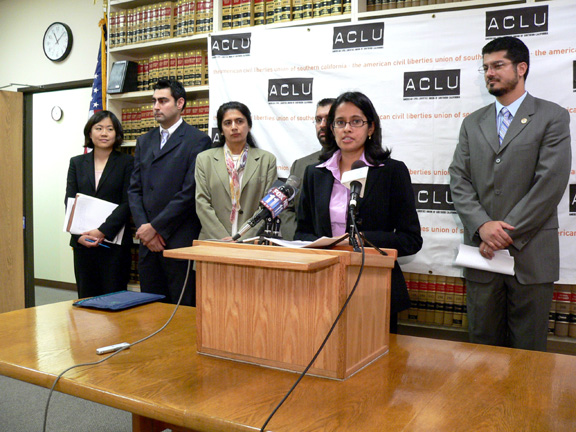
“The lawsuit was the last resort. We’ve tried everything,” said Hussam Ayloush, executive director of the Southern California chapter of the Council on American-Islamic Relations. CAIR worked with the American Civil Liberties Union's Immigrants’ Rights Project to file a class action lawsuit against the government.
With this legal action, the ACLU and CAIR join other grassroots organizations and individuals nationwide to bring attention to the over 40,000 applications for naturalization that have been before the U.S. Citizenship and Immigration Service for over two years. Most often, the hold-up is because of pending FBI name checks.
“Their applications are gathering dust in government offices,” said ACLU attorney Ranjana Natarajan at a press conference Tuesday. “Citizenship is just too important to be postponed for years on end,” she added.
The plaintiffs in the ACLU/CAIR lawsuit include a U.S. military veteran, a medical doctor and a small business owner, among others. They have all passed their English and civics exams and completed the required interview with a U.S. Citizenship and Immigration Service officer.
The legal path to citizenship
From the date of the interview, USCIS has 120 days to decide on the disposition of the application. Most naturalization applications are usually processed within the requisite time frame, and the applicant is invited to be sworn in as a U.S. citizen.
But for these area plaintiffs, 120 days came and went long ago, and they are still waiting to become citizens.
When the plaintiffs followed up with USCIS or with local elected representatives, they found out that they had also been delayed because of incomplete FBI name checks.
“Our clients are the tip of an iceberg,” said Cecillia Wang, senior attorney for the ACLU Immigrants’ Rights Project. She explained that the purpose of the lawsuit is to prevent others who have fulfilled all naturalization requirements from having to live in limbo for years.
“The time is now to solve this problem and to get these agencies to comply with the law,” Wang said.
Ayloush explained that CAIR has worked with government community outreach workers to investigate the cause for the delays. But Ayloush said that even the government workers hit a brick wall when they found out that the hold-up was because of the background checks.
“I hope the government will mend its broken system,” said 25-year-old Irvine resident and Air Force veteran Mustafa Aziz. Aziz successfully passed his naturalization examinations and had his interview in April 2004.
Aziz and his family came to the U.S. as refugees fleeing Afghanistan when Aziz was one-year-old. Aziz, a lawful resident of the U.S. for over 20 years, served in the U.S. Air Force for four years and attained the rank of Senior Airman. Aziz is the only member of his family who is not a U.S. citizen.
The background of background checks
Soon after 9/11, USCIS made the security checks for immigration benefits more stringent, according to USCIS spokesperson Sharon Rummery. In December 2002, USCIS sent over 2.7 million names of people who were in the process of applying for permanent resident status and naturalization to the FBI for an in-depth background check known as a name check. This check is different than the routine FBI criminal fingerprint check that is required, for example, of teachers and day care workers as a routine part of their job applications.
According to FBI spokesperson Stephen Fischer, criminal checks are done to determine whether an individual has been arrested on suspicion of a felony. These checks are a part of the application to become a citizen, but they are usually turned around in about two hours, Fischer said.
“If there is a delay in the process, it’s not here,” Fischer added.
But the name check is a “very complicated process,” said FBI spokesperson Bill Carter. While criminal checks usually clear quickly, the name check is a detailed look into whether a person is the subject of an FBI record.
About five percent of the name checks come back with potential problems; ultimately, only about one percent of the files contain information that is of concern to the FBI. A name check can sometimes involve dozens of other agencies and even other governments, not all of which have friendly relations with the U.S., Carter explained.
Additionally, late in 2002 the FBI ratcheted up the sensitivity of the check to show a “hit” if a person’s name is cross-referenced not just with the subject of another FBI file, but also with any name within that file, Carter said. Then, it takes old-fashioned – and time consuming -- detective work to resolve questions about a person’s background.
Even with the increased sensitivity of its name check, the FBI is still processing more name checks in a year than it receives. The backlog, Carter said, is because the FBI is playing catch-up with the 2.7 million new names submitted by USCIS late in 2002.
“We’re not going to clear somebody until we have obtained an unequivocably correct result,” Carter said.
The FBI will take the time it needs to do the job right, Carter said, so that there are “accurate and thorough results. … We can’t afford to not review every possibility in today’s threat environment.”
Waiting to become a citizen
“I believe a background check is important,” Aziz said. “This is my home and the home of my family, and I want to make sure everyone is safe.” But the checks shouldn’t take years, he said. Aziz wishes to become a commercial pilot, and his lack of citizenship has created obstacles with both furthering his education and with aeronautical job opportunities.
“It’s bittersweet,” Aziz said of his struggle to become a citizen. “There’s a process. I don’t expect them to hand out [citizenship] left and right,” but he said it’s difficult to understand why the government allowed him to serve in the military and then delayed his citizenship application.
“The ultimate goal of every immigrant who comes to the U.S. is to be able to participate fully in society,” said Todd Gallanger, an attorney for CAIR.
All of the plaintiffs in the ACLU/CAIR case have moving stories, Gallanger explained. “They feel American. … They want to vote, participate, care for aging parents.”
In some cases “they are forced to pick between their family obligations and their life in the United States,” Gallanger said.
This is true for 35-year-old Corona resident Yousuf Bhaghani. Bhaghani owns two small businesses and resides in Corona with his wife and three children. Because he is not a citizen, he cannot bring his aging parents to the U.S. to care for them.
“My life is in limbo,” Bhaghani said. “I want to be a full-fledged citizen, and in my heart I already am. … I cannot understand why it is taking so long.”
Bhaghani passed his naturalization exams and had his interview in August 2002. He needed to submit additional documents in February 2003 and has now been waiting over three years for an answer from the government.
“And these [plantiffs] are the easy cases,” Natarajan said. Their records are “clean, impeccable,” but they have still waited years to become citizens.
CAIR’s Chicago chapter and the Arab American Anti-Discrimination Committee have also launched legal actions against the government on behalf of clients experiencing lengthy delays in their citizenship applications.
CAIR Chicago’s suit alleges that the government is deliberately discriminating against Muslim males from Middle Eastern countries by delaying their applications for naturalization.
Ayloush maintained that “whether [the delays are] due to discrimination or incompetence” it is time for them to end so that law-abiding residents who have fulfilled all naturalization requirements can finally become citizens.
While USCIS cannot comment about pending litigation, spokesperson Sharon Rummery did confirm that the agency has made a recent policy change to postpone an individual’s testing and interview date until after the name check has cleared.
USCIS does not have any kind of time frame within which it must receive results of the name check, Rummery said.
“The FBI does the name checks, so we have no control over how much time they take,” she explained.
 Print
Print Bookmark